
Groot Vleeshuis
The butchers’ covered meat hall, built from 1406 to 1419. Hams still hang drying under its impressive wooden roof. Today you can buy and taste East Flemish regional produce here.
Visit in 3DOpens Instant Gent in free roam, right by this place. Free, in your browser.
On the map Visiting ↓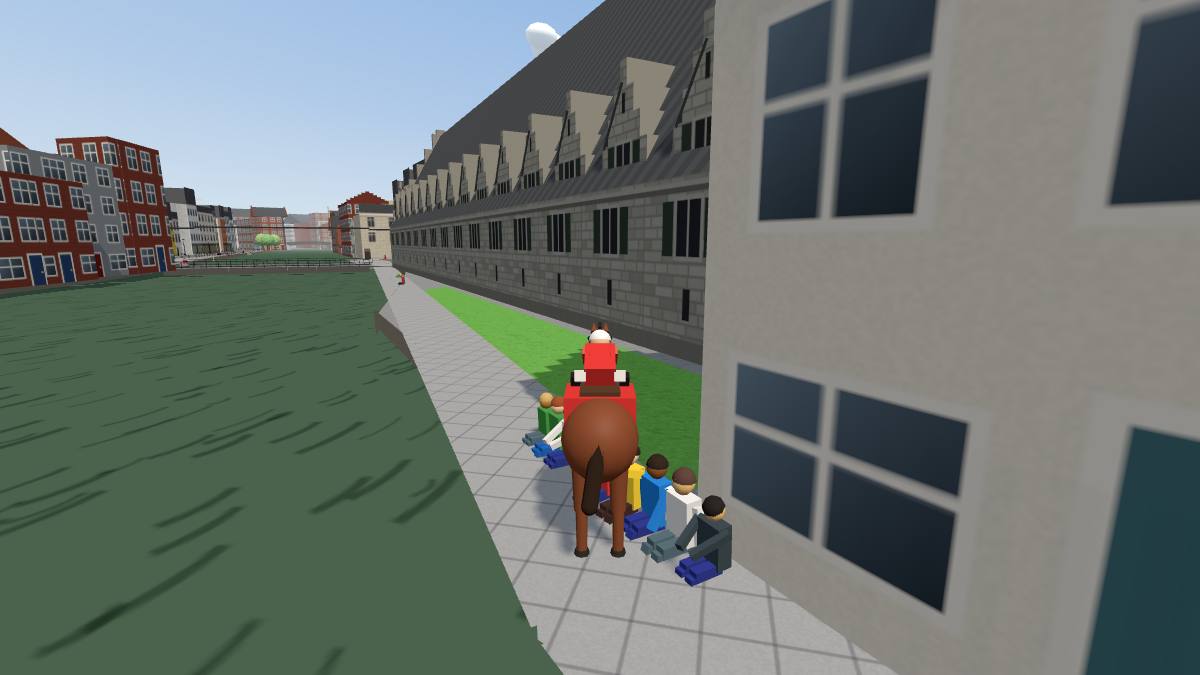
What there is to see
The Great Butchers’ Hall is a long, low hall of grey natural stone on the Leie, with stepped gables at both ends and a row of small dormers. From outside it looks modest, but step inside and you look straight up: the timber roof, an ingenious web of 15th-century oak beams, spans the whole hall without a single pillar in the middle. It is one of the finest medieval timber structures in the country.
Under those beams dozens of Ghent hams still hang drying, as the butchers did centuries ago. Today the hall is a showcase for East Flemish regional produce. You can taste and buy: Ghent mustard, neuzekes (Ghent’s purple cone-shaped sweets), local cheeses, jenever, beer and of course ham. There is also a café where you can eat a regional dish.
Outside, look at the little houses leaning against the wall on the Groentenmarkt: the penshuisjes (tripe houses). That is where the cheaper offal and tripe were sold, which were not allowed in the hall itself. At the back of the hall is a small chapel where the butchers had their mass.
History
In the Middle Ages meat could not just be sold anywhere in Ghent. The butchers’ guild had the monopoly, and all fresh meat had to be offered in this one covered hall, under the city’s supervision. That way the city could check that the meat was fresh and the right taxes were paid. The Great Butchers’ Hall was built between 1406 and 1419, on the site of an older meat hall.
The butchers’ guild was one of the richest and most powerful in the city, and membership passed from father to son. For centuries the people of Ghent came here to buy their meat. The tripe houses were later built against the wall for selling offal and sausages, which the butchers did not want inside the hall.
When the guilds disappeared at the end of the 18th century, the hall lost its purpose. It was used as a warehouse, among other things, and fell into disrepair. After a thorough restoration it gained a new role at the start of the 21st century as a meeting place for good East Flemish food, and so the hams hang there again as they used to.
Visiting
The Great Butchers’ Hall is on the Groentenmarkt, between the Korenmarkt and the Gravensteen, on the Leie. It is free to visit during the opening hours of the shop and café, usually Tuesday to Sunday. Pop in quickly to look at the roof, or take your time to taste and have lunch.
It is the ideal place to take an edible souvenir of Ghent home. From across the Leie you get the best view of the hall’s long front.
Opening hours, prices and tickets change now and then. The latest and fullest practical information is at Visit Gent, the city's tourist office: have a look there before you go.
View on Visit GentSights nearby
- Graslei and Korenlei 130 m
- Gravensteen 144 m
- Graffiti Street 212 m
- St Nicholas’ Church 232 m
Food and drink nearby
- Frituur Filip 6 m
- 't Galgenhuisje 36 m
- Het Spijker 43 m
- 't Dreupelkot 69 m
- Brasserie Paradijs 71 m
- Korenlei Twee 83 m