
Vrijdagmarkt
The square of markets, feasts and uprisings, where the Counts of Flanders were sworn in. In the middle Jacob van Artevelde, the brewer who led Ghent in 1338, points the way. Across the square stands Ons Huis, the big home of the socialist workers’ movement.
Visit in 3DOpens Instant Gent in free roam, right by this place. Free, in your browser.
On the map Visiting ↓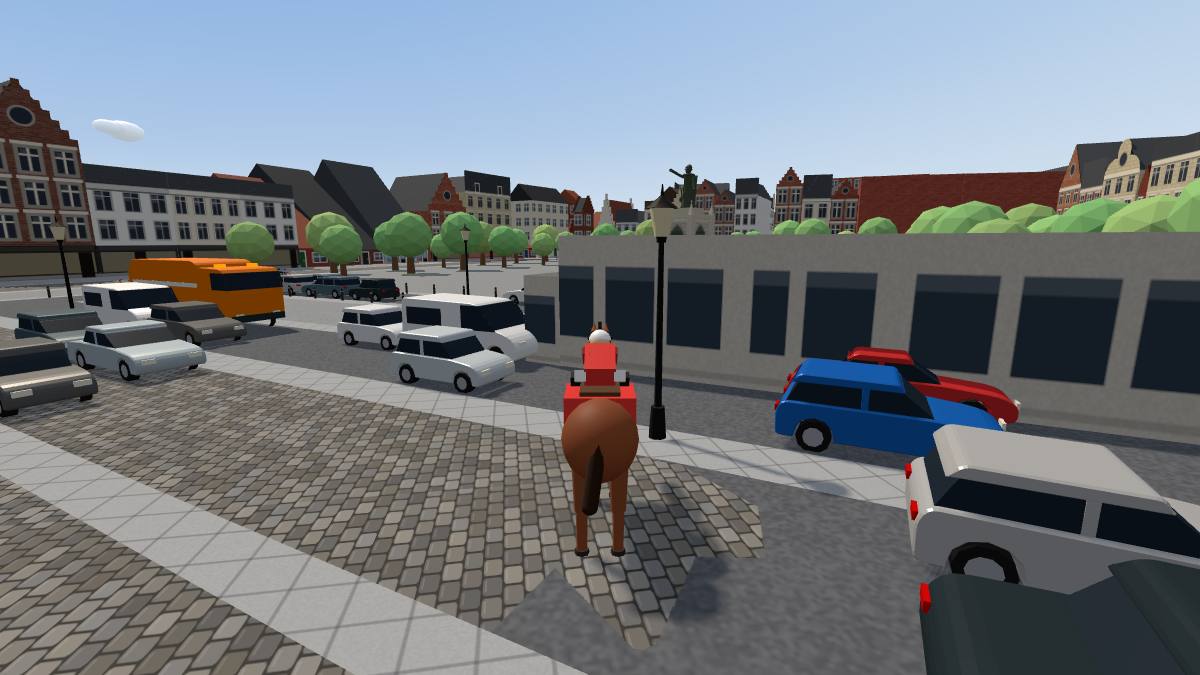
What there is to see
The Vrijdagmarkt is one of the largest and oldest squares in Ghent, and for centuries it was the political heart of the city. It is a broad, open square, ringed by houses with stepped gables, Baroque fronts and big 19th-century buildings, with café terraces all around. In the middle stands the bronze statue of Jacob van Artevelde, pointing west with his arm outstretched: towards England, the country with which he made a crucial deal.
There is a lot to discover around the square. The large Ons Huis (Our House), with its rich, colourful front full of inscriptions, was the headquarters of the socialist labour movement. On the corner stands the Toreken, the tanners’ guild house with its slender tower, now a poetry centre. And at the Dulle Griet café you drink beer from a ‘Max’, a glass of more than a litre, for which you have to hand over one of your shoes as a deposit; it is then hoisted in a basket to the ceiling.
Right next to the square, on the Grootkanonplein, is the Dulle Griet (Mad Meg), a huge red wrought-iron cannon from the 15th century, one of the largest medieval cannons to survive. It was never really used in battle, but it is a much-loved symbol of the city.
History
The name says it all: a market has been held here every Friday (vrijdag) since the Middle Ages. But the Vrijdagmarkt was much more than a market square. This is where the Counts of Flanders were sworn in on their ceremonial entry and promised to respect the city’s rights. Here the guilds gathered, tournaments and feasts were held, and executions too.
In the 14th century Ghent was caught in the Hundred Years’ War between France and England. Ghent lived from cloth-making and needed English wool. In 1338 the wealthy merchant Jacob van Artevelde took charge of the city and kept Flanders neutral, so the wool kept coming. His power did not last: in 1345 he was murdered in a popular uprising. That same year the square saw ‘Evil Monday’, a bloody street battle between the weavers and the fullers that left hundreds dead.
In the 19th century, as Ghent became an industrial city, the Vrijdagmarkt became the square of the labour movement. Around 1900 the Vooruit cooperative built Ons Huis here, with shops, a café and meeting halls for the workers. The statue of Van Artevelde, by Pieter De Vigne, arrived in 1863. Today the square is above all a friendly place of terraces, with an underground car park beneath it.
Visiting
The Vrijdagmarkt is a public square, always open to all, five minutes’ walk from the Gravensteen and the Town Hall. There is still a market on Friday mornings, and often on Saturdays too. Around the square you can eat and drink on plenty of terraces.
Combine your visit with a walk to the Great Butchers’ Hall and the Patershol, or across the bridge to the Dulle Griet cannon and the Kraanlei.
Opening hours, prices and tickets change now and then. The latest and fullest practical information is at Visit Gent, the city's tourist office: have a look there before you go.
View on Visit GentSights nearby
- Graffiti Street 176 m
- City Hall 266 m
- Groot Vleeshuis 319 m
- Mammelokker 344 m
Food and drink nearby
- De Dulle Griet 57 m
- 't Kanon 114 m
- Holy Food Market 154 m
- Soup Lounge 158 m
- Rococo 217 m
- Waterhuis aan de Bierkant 244 m